Commercial Concrete Repair in Duluth, MN — Parking Lots, Floors & Sidewalks
Repairs scoped by what's actually failing and sequenced so the property keeps operating. Including a straight answer when a section is past repairing.
Commercial Concrete Repair in Duluth, MN
Duluth Premier Concrete is your local resource for commercial concrete repair throughout Duluth and St. Louis, Carlton & Lake Counties and the Twin Ports. We work with experienced concrete contractors who scope commercial repairs around what's failing and around the property's operating hours.
Commercial repair is a budgeting problem as much as a technical one. A property has a walkway network, a parking area, entry slabs and maybe an interior floor, all deteriorating at different rates, and a maintenance budget that won't do all of it this year. The valuable work is triage: identifying what's a liability now, what's degrading fast enough to cost more next year, and what can wait — then applying the cheapest adequate fix at each location rather than one treatment everywhere.
The technical half comes down to the same discipline as any repair, scaled up. Repairs fail at the bond line far more often than they fail in themselves, so removal back to sound concrete and mechanical surface profiling are where the money should go. Joints matter more on commercial work than anywhere else — they're where parking lots and industrial floors actually fail, and joint sealing and filling is the highest-value maintenance available on both. And every repair needs the cause addressed, because a commercial property that repairs the same twenty locations every three years is funding a rolling programme rather than a fix.
What's Included in a Duluth Commercial Repair Quote
- Full-property condition survey with locations ranked by hazard and by rate of deterioration
- A recommended fix and cost per location, so a fixed budget can be spent on the highest-value items
- Phasing so entrances, routes, drive lanes and operations stay usable throughout
- Traffic control, barricades, signage and temporary routing, with accessible routes maintained
- Sounding to establish the true extent of delamination beyond the visible damage
- Removal of all unsound, delaminated and contaminated concrete back to solid material
- Mechanical surface profiling — grinding, scarifying or shot blasting — for reliable bond
- Exposure, cleaning, treatment or replacement of corroding reinforcement
- Crack routing and filling, with flexible filler on working cracks and rigid on static ones
- Partial-depth patching and full-depth panel replacement as each location warrants
- Joint cleaning, resealing and semi-rigid filling where wheel traffic crosses
- Correction of the drainage or water source driving the deterioration
- Rapid-set materials where a return-to-service window demands it
- Restriping and reinstatement of markings, and documentation of the work performed
Commercial Concrete Repair in Duluth, MN
Commercial Concrete Crack Repair
Cracks on a commercial property divide the same way they do anywhere — static or working — but the consequences differ. On a parking lot or an industrial floor, an unrepaired working crack gets trafficked, its edges spall, and it widens into a maintenance problem that eventually needs a panel rather than a filler. Static shrinkage cracks get routed to a clean profile and filled with a rigid material. Working cracks get a flexible semi-rigid filler that supports the edges under wheel load while accommodating movement — that edge support is the part that matters on trafficked concrete, and it's why a soft caulk-type sealant is the wrong product on a floor a forklift crosses. Cracks that are symptoms of settlement don't get filled at all until the cause is understood, because filling one is cosmetic work on concrete that's still moving.
Parking Lot Concrete Repair
Parking lot repair is mostly panels and joints. Concrete's jointed construction means individual failed panels can be saw-cut out and replaced without touching the rest of the lot, which contains cost enormously — a lot with fifteen failed panels out of two hundred is a manageable project rather than a repaving. Joint maintenance is the other half and it's the highest-return work available on a lot: open joints let salt-laden meltwater straight to the base, which is what causes the settlement and pumping that produces the next round of failed panels. Sealing joints is cheap and it's the single best thing an owner can do for a concrete lot's lifespan in this climate. The scoping judgment is whether failures are scattered — a panel-replacement job — or concentrated in one area, which usually means the base or the drainage there is the real problem.
Commercial Sidewalk Repair
Walkway repair on a commercial property is trip-hazard management with an appearance requirement attached. The three fixes sit at very different price points: grinding a lip to a taper, lifting a settled panel back to grade with slabjacking or foam injection, and replacing the panel outright. Choosing correctly across a whole property is worth more than any single repair — a fixed budget spent on grinding and lifting removes far more hazard than the same budget spent replacing a handful of panels. Documentation is part of the value here too. A dated condition survey with hazards identified, ranked and addressed puts an owner in a substantially better position than having no record, and it costs almost nothing to produce alongside the work. Customer-facing walkways carry the extra constraint that a patch reads as a patch, which often argues for full-panel replacement at entrances.
Warehouse & Industrial Floor Repair
Interior floor repair is dominated by joints, because that's where industrial floors fail. Hard-wheeled traffic crossing an unsupported joint edge chips it progressively until the floor is rough enough to damage equipment and shake loads. The repair is to rebuild the spalled edges with a suitable material and fill the joint with a semi-rigid filler that supports the edges under load rather than a soft sealant that doesn't. Beyond joints, the common jobs are surface delamination where a weak finish layer is separating, cracks that have opened and where panels now rock under a lift, and localized damage from impact or point loads. Downtime is usually the binding constraint, which pushes toward rapid-set materials that return an area to traffic in hours rather than days — those cost more per unit and are frequently the cheaper option once lost operating time is counted.
Damaged Concrete Removal & Replacement
The point where repair stops making sense. Every property has locations where the deterioration is extensive enough that patching costs more than replacing, looks worse, and doesn't reset the clock — and identifying those honestly is more useful than quoting repairs on all of them. The threshold is roughly where you'd be patching a majority of a panel or an area, where the concrete has lost integrity through its depth, or where the slab has moved and no surface treatment reaches the cause. On a commercial property, full-depth panel replacement is often surprisingly economical precisely because concrete is jointed: cut at the joints, remove, rebuild the base, repour. The result is a genuinely new panel rather than a repaired old one, at a cost that competes with an extensive patch, and with a lifespan that isn't tied to how well a bond line holds.
Signs Your Commercial Concrete Needs Repair
- Trip hazards on public walking surfaces, whether reported by an inspection or noticed by staff
- Joint edges spalling on an interior floor, roughening the ride for lifts and shaking loads
- Parking lot panels that rock under vehicles or have settled below their neighbors
- Open, unsealed joints across a lot — the direct route for salt-laden meltwater to the base
- Potholes, patches and localized repairs recurring in the same locations every couple of years
- Rust staining or hollow-sounding areas, indicating corroding reinforcement below the surface
- Ponding water that freezes into a hazard at the same spots every thaw
- Surface deterioration at entrances that has become an appearance problem for the business
How Commercial Concrete Repair Works
- 1
Survey the property and rank by risk and rate
A commercial repair project should start with a survey of everything, not a quote for the spot somebody reported. Each location gets assessed for what's failing, why, how urgent it is, and what the cheapest adequate fix would be. Sounding with a hammer or chain drag finds delaminated areas that look intact from the surface, which is how the real extent gets established rather than guessed — and on commercial work that difference routinely doubles a scope once removal starts. The output is a ranked list with costs, which lets an owner allocate a fixed budget rationally: the highest-hazard locations get addressed, the fast-deteriorating ones get addressed before they get expensive, and the cosmetic ones wait. That document is also worth keeping, because a dated record showing hazards were identified and prioritized is a meaningfully better position than no record at all.
- 2
Plan phasing and return-to-service windows
The sequence is designed around the property's operation rather than the crew's convenience. Which areas can close and when, whether work happens at night or on weekends, how long each area is out of service, and what the temporary arrangement is. Return-to-service time is often what selects the repair material: a standard cementitious repair mortar may need days before traffic, while a rapid-set material can be trafficked in hours at a higher material cost — and on a busy loading dock or a retail entrance, the rapid-set option is usually cheaper once lost operating time is counted. Notification goes to tenants and staff with real dates. Traffic control, barricades and signage get planned, and where the work affects walking routes, accessible parking and routing stay available throughout rather than being closed for the duration.
- 3
Remove to sound concrete and prepare the surface
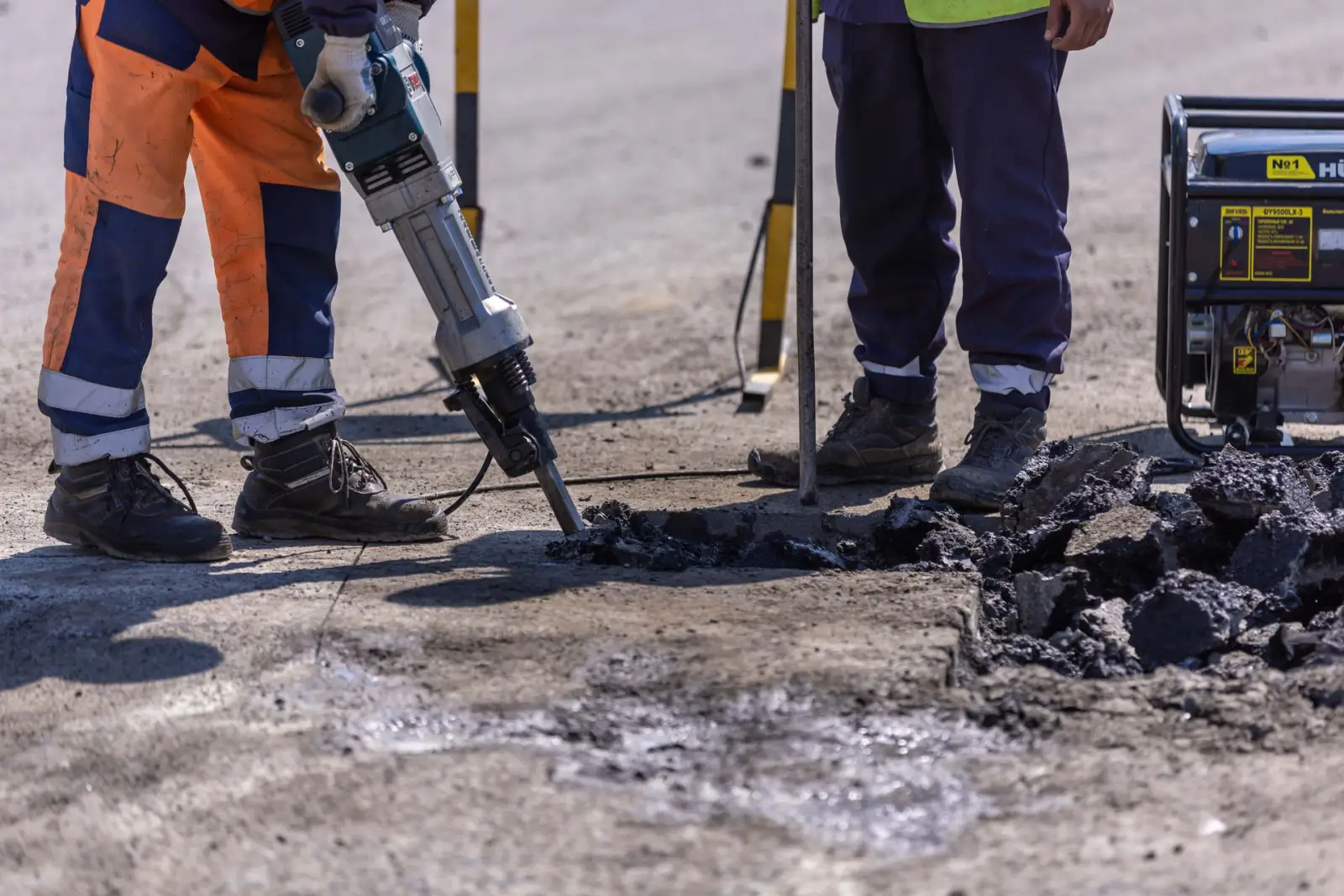
This is where commercial repairs succeed or fail, and it's the step under most pressure from a schedule. All loose, delaminated, cracked and contaminated concrete comes out, back to solid material — which means the repair area routinely ends up larger than the visible damage. Patch perimeters are saw-cut square rather than feathered, because a feathered edge is thin and breaks away first. Where reinforcement is exposed and corroding, concrete is removed from all the way around the bar so the steel can be cleaned or replaced and treated; patching over rusting steel produces a repair that pops off along with more concrete a few years later. Then mechanical profiling — grinding, scarifying or shot blasting to the profile the repair material specifies — followed by thorough cleaning, because dust sitting in a fresh profile is a bond breaker in exactly the wrong place.
- 4
Place, cure, seal joints and fix the cause
Materials are selected for the exposure and the return-to-service window, mixed to the specified water ratio, and placed at the substrate moisture condition the product data sheet calls for. Repairs are finished to match the surrounding surface, including broom direction on exterior work. Curing gets protected, and it matters more on a thin patch than on a slab because the surface-area-to-volume ratio dries a repair out fast. Joints across the work area get cleaned and resealed, with semi-rigid filler where wheel traffic crosses them, since that edge support is what stops the next round of spalling. And the cause gets addressed — the downspout rerouted, the low area regraded, the drainage structure cleared. A commercial repair programme that never touches the causes turns into a recurring annual line item, which is exactly what most owners are trying to get out of.
What Does Commercial Concrete Repair Cost in Duluth, MN?
- Number of locations and the fix type at each — grinding, lifting, filling, patching or panel replacement
- The true extent of unsound concrete, which sounding usually reveals to be larger than it looks
- Surface preparation method and area, which is a substantial share of repair labor
- Exposed reinforcement requiring cleaning, treatment or replacement
- Material selection, particularly rapid-set products chosen for a short return-to-service window
- Phasing — night, weekend or sectioned work versus a single continuous closure
- Traffic control, barricades, signage and temporary routing
- Joint cleaning, resealing and semi-rigid filling across the surrounding area
- Drainage or water-source correction driving the deterioration
- Interior work, where dust containment and access constraints slow everything
- Restriping, markings and site reinstatement
- Condition survey documentation and any testing required
Commercial repair prices per location and per fix type, which is exactly why a triage survey pays for itself — the same budget spent on grinding and joint sealing across many locations removes far more risk than it would replacing a few panels. The honest warning is about scope growth: sounding routinely finds delamination well beyond the visible damage, and cutting back to sound concrete is the only way a repair holds, so a quote written from what's visible will be revised once removal starts. Ask for the survey to include sounding. The other consideration is the false economy of a repair programme with no cause correction, which converts a fixable problem into a permanent annual line item.
What to Look for in a Duluth Commercial Concrete Repair Contractor
They survey the whole property and rank it
A ranked list of locations with fix options and costs lets an owner spend a fixed budget where it removes the most risk. A quote for whichever spot got reported is a quote for one problem, not for the property.
Sounding happens before the number is written
Delamination doesn't show at the surface. A contractor who sounds the concrete and prices the real extent is giving you a number you can budget against. One who prices what's visible is giving you a starting point.
Return-to-service drives the material choice
On an operating property, lost hours cost more than material does. A contractor who proposes a rapid-set product for a retail entrance and a standard one for a back lot is optimizing your total cost rather than their material bill.
Joint sealing gets pushed, even though it's cheap
Open joints are how water reaches the base and how the next round of panel failures gets created. It's low-margin, high-value work, and a contractor who leads with it rather than with replacement is telling you something useful.
Property Types We Cover
Residential
Residential concrete repair — driveways, patios, walks and steps on single-family property — is covered on its own page. The materials and the preparation discipline are the same; what's absent is the phasing, the traffic control, the documentation and the portfolio-level triage that shape commercial work.
Commercial
Retail and office property, apartment and condominium complexes, warehouses and industrial buildings, medical and institutional sites across the Twin Ports. Scope runs from a single trip hazard to a phased multi-location programme across a full property, sequenced so operations continue throughout.
When Commercial Concrete Repair Isn't the Right Call
- A location that's genuinely past repairing. Where you'd be patching most of a panel or an area, full-depth replacement costs less, works better and lasts longer. A contractor should be telling you which locations those are rather than quoting patches on all of them.
- A site-wide failure. If a whole parking area or walkway network has failed, the base or the drainage is the cause, and a repair programme within it becomes a rolling annual cost. Price replacement alongside repair before committing to years of patching.
- Tight, level cracks doing no harm. Concrete cracks as it cures. On a surface with no hazard, no water ingress and no wheel traffic across the crack, leaving it alone is a legitimate budget decision.
- Structural repair to a building frame or foundation. That's a structural engineering scope with a different specialty behind it, and it starts with an assessment rather than with repair mortar.
- Property outside St. Louis, Carlton and Lake Counties. Mobilizing for distributed small repairs a long way out doesn't price sensibly for either side.
Frequently Asked Questions
- How do we prioritize repairs across a whole property?
- With a condition survey that ranks locations by hazard and by how fast each is deteriorating, and that names the cheapest adequate fix at each one. That lets a fixed budget go to the highest-risk items using the least expensive treatment that works — which removes far more risk than spending the same money replacing whichever areas looked worst.
- Can repairs be done without closing the property?
- Almost always, by phasing and by material selection. Work is sectioned so routes and operations continue, and rapid-set materials can return an area to traffic in hours where a standard repair mortar would need days. On a busy entrance or loading dock, the rapid-set option is usually cheaper once lost operating time is counted.
- Why is joint sealing so important on a commercial lot?
- Because open joints are the direct route for salt-laden meltwater to reach the base. Once water gets under the slab it drives settlement, pumping and the freeze-thaw cycling that creates the next round of failed panels. Joint sealing is cheap, low-margin work and it's the highest-return maintenance available on a concrete lot in this climate.
- Why did our last repair fail?
- Most commercial repairs fail at the bond line, and the usual causes are preparation: unsound concrete left in place, no mechanical profiling, dust in the profile, or the wrong substrate moisture condition. The other common cause is an uncorrected source — a repair over concrete that's still moving, or where water is still arriving, has a built-in expiry date.
- Should we repair or replace failed parking lot panels?
- Where failures are scattered, panel replacement is efficient — cut at the joints, remove, rebuild the base and repour, and you get a genuinely new panel at a cost that often competes with an extensive patch. Where failures are concentrated in one area, the base or drainage there is the real problem and needs addressing, or the same panels fail again.
- Can concrete repairs be done in winter?
- Some. Most cementitious materials need temperatures above freezing to cure, and cold-weather work means heating and protection at real cost. Certain rapid-set and polymer products carry lower temperature ratings and can handle an urgent trip hazard or a critical floor repair. For a planned programme, scheduling into the season produces a better result for less money.
Learn More
- International Concrete Repair Institute — The trade body for concrete repair — technical guidelines on surface preparation, bond, corroding reinforcement and material selection.
- American Concrete Pavement Association — Guidance on concrete pavement maintenance, joint sealing and panel replacement practice for parking and industrial pavement.
- ACI — Resistance to Cycles of Freezing and Thawing — Why de-icing chemicals and freeze-thaw cycling deteriorate commercial concrete surfaces the way they do in this climate.
Need Commercial Concrete Repair in Duluth, MN?
Tell us what’s going on and get an on-site estimate — no charge for the visit, and no obligation to book the work.
Get My Free Estimate