Stamped Concrete in Duluth, MN — Patios, Driveways & Decorative Walkways
Slate, ashlar, wood-plank and cobble patterns in integral or hardener color, installed with the sealer schedule this climate actually requires. Free on-site estimate.
Stamped Concrete in Duluth, MN
Duluth Premier Concrete is your local resource for stamped concrete throughout Duluth and St. Louis, Carlton & Lake Counties and the Twin Ports. We work with trusted concrete finishers who will tell you where stamping holds up here and where it doesn't.
Stamped concrete is a finishing operation on an ordinary slab. The base, the mix, the reinforcement and the joints are the same work that goes under a broom-finished patio; the difference is what happens in the two-hour window when the concrete is firm enough to hold an impression and soft enough to take one. That window is why stamping is a crew-size job — patterning 600 square feet before the slab goes off takes more hands than screeding it did.
The honest version of the pitch for this climate: stamped concrete looks like stone at a fraction of stone's cost, and it needs maintenance that plain concrete doesn't. Color and pattern live at the surface, and the surface here gets snow load, shovels, and whatever salt tracks in off the street. A sealer renewed on schedule keeps a stamped patio looking close to new for a long time. A sealer skipped for four years leaves you with a faded pattern and no cheap way back. Anybody who sells you stamped work without that conversation has left out the part that costs you money later.
What's Included in a Duluth Stamped Concrete Quote
- Base and slab built to the same standard as any exterior flatwork — compacted Class 5, 4,000 psi air-entrained mix at 5 to 8 percent air
- Fiber mesh or rebar reinforcement sized to the application
- Integral color mixed at the plant, or color hardener broadcast and floated into the surface
- Release agent, in a contrasting or matching tone, to keep the mats clean and add secondary color
- Pattern stamping with mats, plus hand-tooling at edges and obstructions the mats can't reach
- Detail work: touch-up on grout lines, hand-chiseled edges, and border treatment
- Saw-cut control joints placed along pattern lines wherever the layout allows
- Wash-off, cure, and the first coat of sealer once the slab is dry enough to take it
- A written maintenance schedule — when to re-seal, what to use for traction, what not to put on it
Stamped Concrete Installation in Duluth, MN
Stamped Concrete Patios
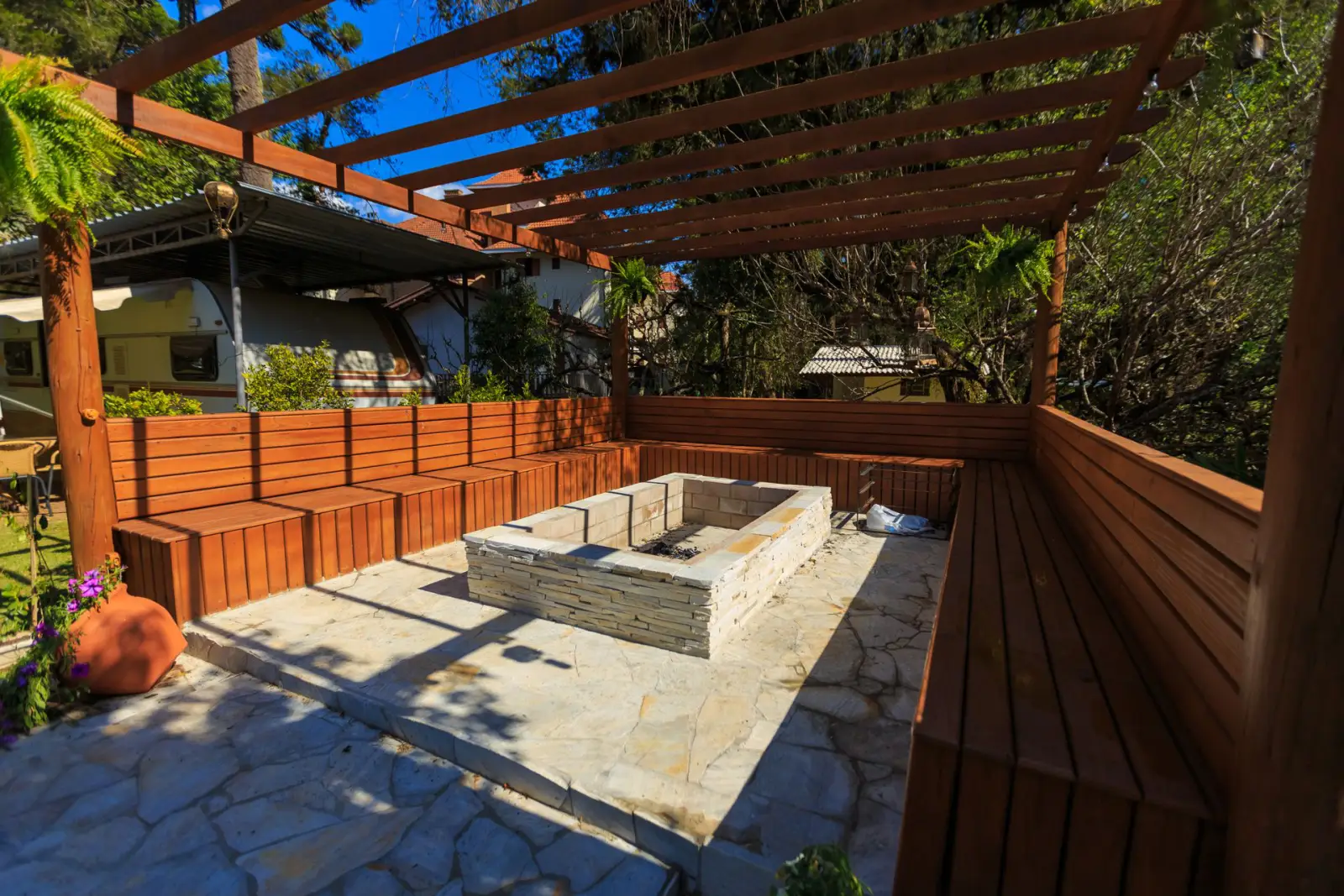
The most common stamped application here, and the one the material suits best. A patio doesn't get plowed, doesn't get salted if you don't salt it, and spends the worst months under insulating snow rather than under tire chains. That combination means a stamped patio holds its pattern and color far longer than a stamped driveway will. Ashlar slate and random stone patterns are the usual choices because their irregular grout lines hide the seams between mat placements and forgive the small inconsistencies that come with a hand process. Pattern scale is worth thinking about: a large-format pattern on a small patio reads as three stones and a lot of grout, while a fine pattern across a big slab turns busy. Walking a sample board on-site beats picking from a catalog page photographed in Arizona sunlight.
Stamped Concrete Driveways
Possible, common, and the version that needs the clearest warning. A driveway is the one slab on the property that gets a plow blade, tire chains, road salt tracked off the street, and hot tires that lift sealer. Stamped driveways in this climate can look excellent, and they need sealer renewed more often than a patio does — and a plow operator who knows to keep the blade shoed up off the surface. Where a client wants the look without the exposure, a stamped border with a broom-finished field is the compromise that actually survives: the decorative work sits at the edges where the plow doesn't run, and the traffic lane is a surface that shrugs off abuse. If a contractor quotes a fully stamped driveway without raising any of this, that is a useful signal about the rest of the job.
Stamped Concrete Walkways
Front walks, side paths and the run from a driveway to a back patio. Walkways are a good stamped application for a practical reason: they are narrow, so the pattern reads at the scale a person actually sees it, and they are small enough that the cost premium over a broom finish is modest in absolute dollars. Traction is the design constraint. A heavily textured stone pattern gives good grip, but a smooth slate or a polished-looking finish on a walkway that ices over is a genuine hazard, and the sealer choice makes it worse or better — a high-gloss sealer without a grit additive turns a wet walk slick. Where a walkway is the main route to a front door in December, the sensible specification is a textured pattern plus an anti-slip additive broadcast into the sealer.
Stamped Concrete Patterns & Textures
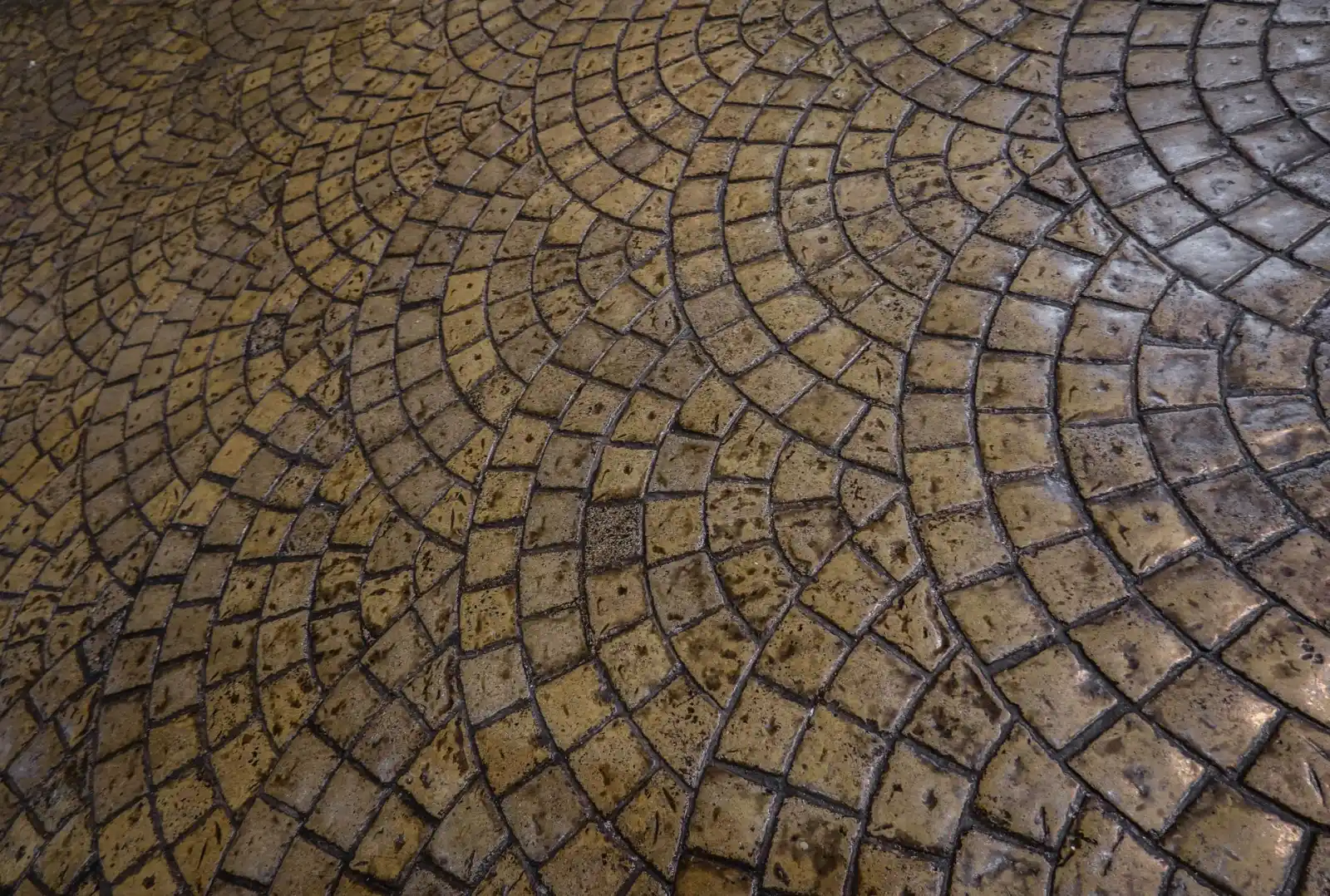
Mat patterns fall into a few families. Ashlar and random slate imitate cut and irregular stone with deep grout lines, and they are the most forgiving of a hand process. Running-bond and herringbone brick patterns read tighter and more formal, and they punish an out-of-square layout because the eye follows the lines. Cobble and fan patterns — the circular European fan is a common driveway apron treatment — carry a lot of visual weight and work better as an accent than across a whole surface. Wood-plank stamps have become popular and are the trickiest to do convincingly, because plank ends have to be staggered by hand or the repeat becomes obvious. Texture skins are the quiet option: they add stone-like surface texture with no repeating pattern at all, which ages better than a pattern that dates itself.
Colored & Decorative Stamped Concrete
Color arrives two ways. Integral color is mixed into the concrete at the plant, so the pigment goes all the way through — a chip or a wear spot exposes the same color rather than grey underneath, which makes it the durable choice for anything that will see traffic. Color hardener is broadcast onto the fresh surface and floated in, producing a denser, harder wearing surface layer and a richer, more saturated color than integral can reach, but only in the top layer. Most work here uses one, the other, or both, with a contrasting release agent worked into the grout lines to give the depth that makes a stamp look like stone rather than like patterned concrete. Antiquing washes and accent stains are applied after cure for the same reason. All of it lives under the sealer, and all of it fades if the sealer isn't maintained.
Stamped Concrete vs. Pavers in a Freeze-Thaw Climate
How each handles frost movement
Pavers are individual units on a flexible bedding course; when the ground moves, they move with it and can be lifted and reset. A stamped slab is one rigid piece — it moves as a unit and cracks where the stress exceeds it. On ground you trust, the slab wins on appearance and continuity. On ground you don't, pavers are the more forgiving system.
Repairability
A damaged paver is pulled and replaced for the cost of one paver. Stamped concrete does not patch invisibly — matching color, pattern and weathering on a repair is close to impossible, which is why the realistic repair for a badly cracked stamped panel is saw-cutting and replacing the whole panel. Plan the joint layout with that in mind.
Maintenance load
Stamped concrete needs sealer renewed on a cycle; pavers need joint sand replenished and weeds managed. Neither is maintenance-free. The difference is what failure looks like: neglected pavers get weedy and uneven, neglected stamped concrete goes dull and grey and can't be brought back without recoating or resurfacing.
Continuous surface vs. joints
A stamped slab has no real joints for snow to catch on, so it shovels and plows cleanly. Pavers have a joint every few inches, which a shovel blade can catch and a plow can chip. For a surface you will clear thirty times a winter, that is a genuine functional difference in concrete's favor.
Signs Stamped Concrete Is the Right Choice
- You want the look of cut stone or brick without stone or brick pricing
- The surface will be cleared of snow regularly, and you would rather not shovel across paver joints
- You are already pouring a patio or walkway and the pattern is an upgrade to work that's happening anyway
- An existing plain slab is sound but visually dated, and an overlay stamp is on the table
- You want a continuous surface — no weeds coming up through joints, no units to reset
- The design calls for curves or an irregular footprint that would mean a lot of cut pavers
- You are willing to re-seal on a schedule, and want that written into the quote
How Stamped Concrete Is Installed
- 1
Pattern selection, color and a sample on-site
This step happens before anything is dug, and skipping it is the most common source of disappointment with stamped work. Pattern and color are chosen from real samples in your own light, not from a catalog — concrete color reads differently under an overcast Duluth sky than it does in a photograph shot in full southwestern sun, and the release agent's contrast changes the result as much as the base color does. Scale gets checked against the actual footprint: a large ashlar across a small patio produces three stones and a lot of grout line. This is also where the practical constraints get named — whether the surface will be plowed, whether it is the main winter route to a door and therefore needs an anti-slip additive, and what the re-seal interval will be. A sample board left on-site through a rain gives you the wet-surface answer too.
- 2
Base, forms and slab preparation
Identical to any exterior flatwork, because that is what it is. Organics stripped, subgrade cut to depth and repaired where it's soft, four inches of Class 5 aggregate compacted in lifts, forms set to hold the pitch. Reinforcement goes in — fiber mesh as standard, rebar on chairs where the slab spans fill or will see vehicles. The mix is 4,000 psi with 5 to 8 percent entrained air, and if integral color is being used it is added at the plant and the whole pour has to come from the same batching to avoid a visible color break between trucks. That last detail matters: a color change mid-slab is permanent. Joint layout is planned here as well, so the saw cuts can be dropped along pattern grout lines later instead of slicing across the middle of a stone.
- 3
Placement, color hardener and the stamping window
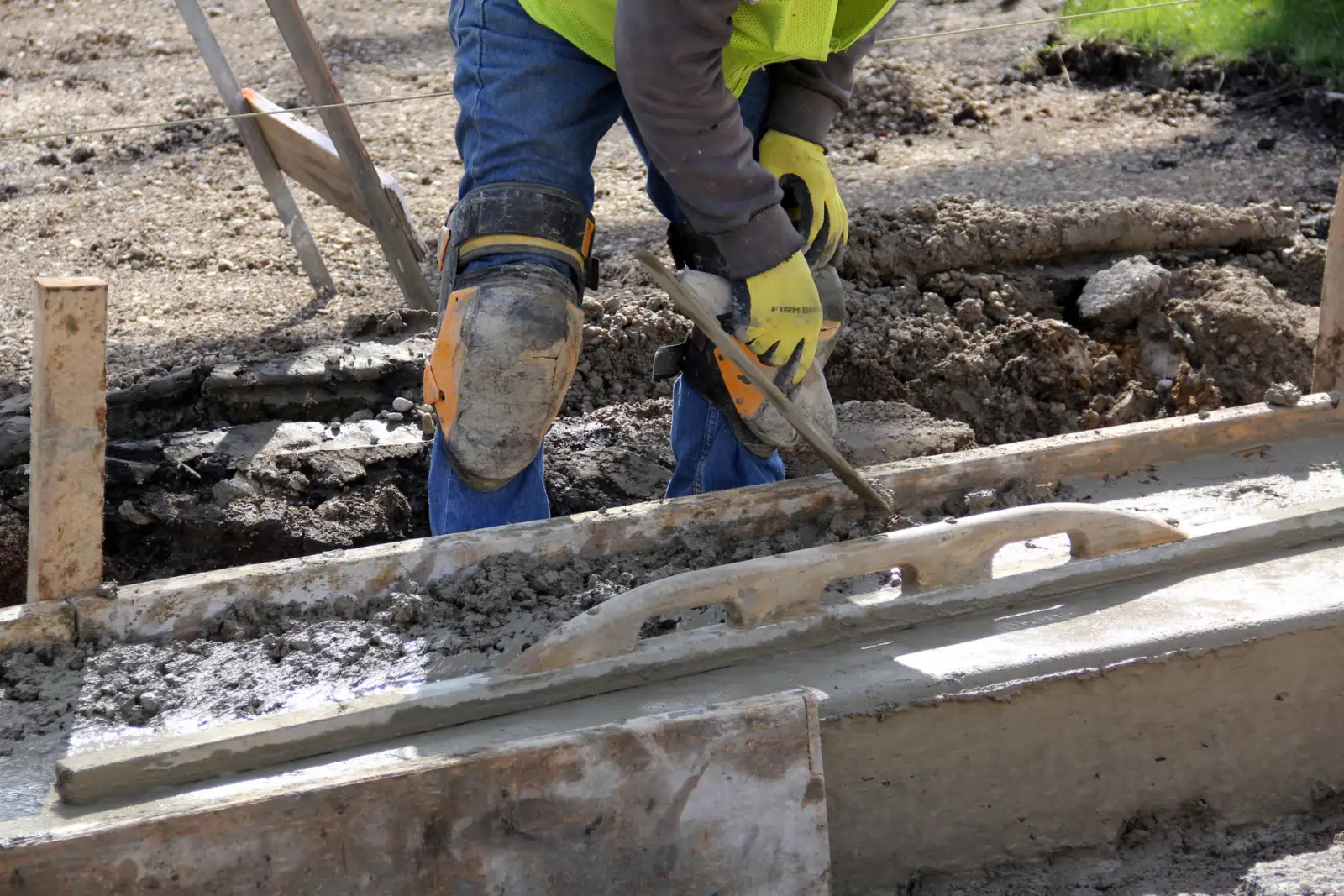
Concrete is placed, screeded and bull-floated. If color hardener is being used it gets broadcast across the surface in two applications and floated in, which both colors and densifies the top layer. Then the crew waits for the slab to reach the right stiffness — firm enough that a mat leaves a crisp impression that doesn't slump, soft enough that the mat still sinks to full depth. That window is short and it moves with air temperature, sun, wind and the mix itself, which is why stamping is scheduled as a crew operation rather than fitted around other work. Release agent goes down first, powdered or liquid, to keep the mats from sticking and to lodge secondary color in the grout lines. Mats are then placed in sequence and tamped, with hand tools finishing the edges, the perimeter and anywhere a mat can't reach.
- 4
Cure, wash-off, joints and first seal
The slab cures before anything else happens to it. Once it is hard, the excess release agent gets washed off — this is the step that reveals the actual color, and it is normal for a stamped surface to look wrong until it happens. Control joints are saw-cut, placed along pattern grout lines wherever the layout allows so they disappear into the design rather than reading as a cut. Then the slab has to dry properly before sealer goes on; sealing over trapped moisture produces a cloudy white blush that has to be stripped and redone. The first sealer coat goes on when the slab is dry, with an anti-slip additive broadcast in where the surface is a winter walking route. After that it is a maintenance item: expect to re-seal on a cycle, more often on a driveway than a patio, and expect the surface to tell you when it is due by going dull.
What Does Stamped Concrete Cost in Duluth, MN?
- Square footage, and how much of the perimeter needs hand-tooling rather than mat work
- Pattern complexity — a single running-bond mat set is faster than a multi-mat random stone layout
- Color method: integral only, color hardener, or both plus an accent stain
- Whether this is a new slab or a stamped overlay over existing sound concrete
- Base and site conditions, exactly as they would be for any patio or driveway
- Borders and banding, which are a second pattern and a second setup
- Anti-slip additive and sealer type, and whether the first re-seal is included in the quote
- Access and crew size, since the stamping window is fixed and a bigger slab needs more hands at once
Stamped and decorative concrete typically runs $8 to $18 per square foot, against $5 to $13 for standard concrete work in this market — so the pattern is roughly a 50 to 100 percent premium over a broom finish on the same slab. The number that doesn't appear in that range is the maintenance one. Sealer is not optional on stamped work; it is the thing protecting the color, and it has to be renewed on a cycle for the life of the surface. Budget for it the way you'd budget for staining a deck. A stamped patio that gets re-sealed on schedule looks close to new for a very long time; one that doesn't goes flat and grey, and bringing it back costs materially more than the sealer would have.
What to Look for in a Duluth Stamped Concrete Contractor
They bring samples to your site, in your light
Color chosen from a catalog is color chosen under someone else's sun. A contractor who leaves a sample board on-site through a rain is showing you what the surface looks like wet, which is how you'll see it a lot of the year.
The sealer schedule is written into the quote
Stamped concrete is a maintained surface. An estimate that names the sealer product and the re-seal interval is an estimate from someone who intends you to be happy in year five, not just at handover.
They will talk you out of stamping a plow lane
The contractor who says a fully stamped driveway will need more upkeep, and offers a stamped border with a broom-finished traffic lane instead, is giving up revenue to give you a better outcome. That is the signal worth paying for.
Enough hands for the stamping window
The window between too soft and too hard is short and it doesn't negotiate. Ask how many people will be on-site the day of the pour. A two-person crew stamping a large patio is a pattern that gets worse as it goes.
Residential & Commercial Stamped Concrete
Residential
Stamped work here is overwhelmingly residential — a Congdon Park patio in ashlar slate, a Lakeside front walk, a fan-pattern apron at the top of a driveway where it reads without taking plow blade. The pour season is short, and stamping needs a day with workable temperatures and no rain in the window, which narrows it further.
Commercial
Commercial stamped work shows up at entries, courtyards and outdoor seating areas where a property wants a stone look without a stone budget. Traffic volume is the difference: a restaurant patio takes more foot traffic in a summer than a home patio takes in a decade, so color hardener and a harder-wearing sealer usually replace integral color alone.
When Stamped Concrete Isn't the Right Call
- A driveway that gets plowed by a contractor with a steel blade. Stamped concrete under a plow will need re-sealing more often and will eventually show blade marks. Stamp the border, broom the traffic lane, and keep both.
- Anyone who won't re-seal it. This is the honest disqualifier. If maintenance isn't going to happen, a broom finish or exposed aggregate will look better in year eight than neglected stamped concrete will, and it costs less up front.
- A slab that has already cracked and settled. Stamping an overlay across a moving slab reproduces the crack through the new surface, usually within a year. The slab gets fixed or replaced first, or not at all.
- The primary winter path to a door, if you want a smooth slate look. A low-texture pattern under a gloss sealer is genuinely slippery when wet or iced. Textured pattern plus anti-slip additive, or a different surface entirely.
- A budget that only just covers a plain slab. Stamping is a real premium. Pouring a good plain slab now and resurfacing with a stamped overlay in a few years is a legitimate plan; stretching the budget by thinning the base is not.
Frequently Asked Questions
- How much does stamped concrete cost in Duluth?
- Stamped and decorative concrete generally runs $8 to $18 per square foot here, compared with $5 to $13 for standard concrete work. The spread within that range comes from pattern complexity, whether color hardener is used on top of integral color, and how much hand-tooling the perimeter needs. Budget separately for sealer renewal over the life of the surface.
- Does stamped concrete hold up to Duluth winters?
- The slab does, if it was built right — same 4,000 psi air-entrained mix, same compacted base, same saw-cut joints as any exterior flatwork. What is exposed is the color and sealer at the surface. Snow itself is harmless and actually insulating; salt and a plow blade are what shorten a stamped surface's good-looking life.
- How often does stamped concrete need to be re-sealed?
- It varies with exposure rather than following a fixed calendar, and the surface tells you: when the color looks flat and water stops beading, it is due. A patio goes longer between coats than a driveway does, and a surface that gets salted goes shortest of all. Ask the contractor to name an expected interval for your specific application and put it in writing.
- Is stamped concrete slippery?
- It can be, and it depends on pattern texture and sealer. A deep stone texture with a matte sealer has good grip. A low-texture pattern under a high-gloss sealer is genuinely slick when wet. For any surface that is a winter walking route, specify a textured pattern and an anti-slip additive broadcast into the sealer — it is a small cost at install and impossible to add cheaply later.
- Can stamped concrete be applied over an existing slab?
- Yes, as a stamped overlay, and only if the existing slab is structurally sound — no settlement, no cracks that have stepped out of level, no widespread scaling. An overlay follows what's underneath it, so a moving slab telegraphs its cracks through the new surface. The slab gets assessed honestly first; sometimes the answer is that it needs replacing instead.
- Will the color fade?
- Integral color goes through the full depth of the slab and is very stable, though UV will soften it slowly. Color hardener and surface-applied stains live in the top layer and depend on sealer for protection. Faded stamped concrete is almost always a sealer maintenance story rather than a pigment quality one, and a recoat usually brings most of it back.
Learn More
- ASCC Decorative Concrete Council — The American Society of Concrete Contractors' decorative division — industry guidance and technical bulletins on stamping, coloring and sealing.
- ACI — Resistance to Cycles of Freezing and Thawing — Why entrained air matters in any exterior slab, decorative or not, and what happens at the surface when it's missing.
- NRMCA — Criteria for Freeze-Thaw Resistant Concrete Mixtures — The mix-design side of the same question, including the 5 to 8 percent air content range specified for exterior work.
Need Stamped Concrete in Duluth, MN?
Tell us what’s going on and get an on-site estimate — no charge for the visit, and no obligation to book the work.
Get My Free Estimate