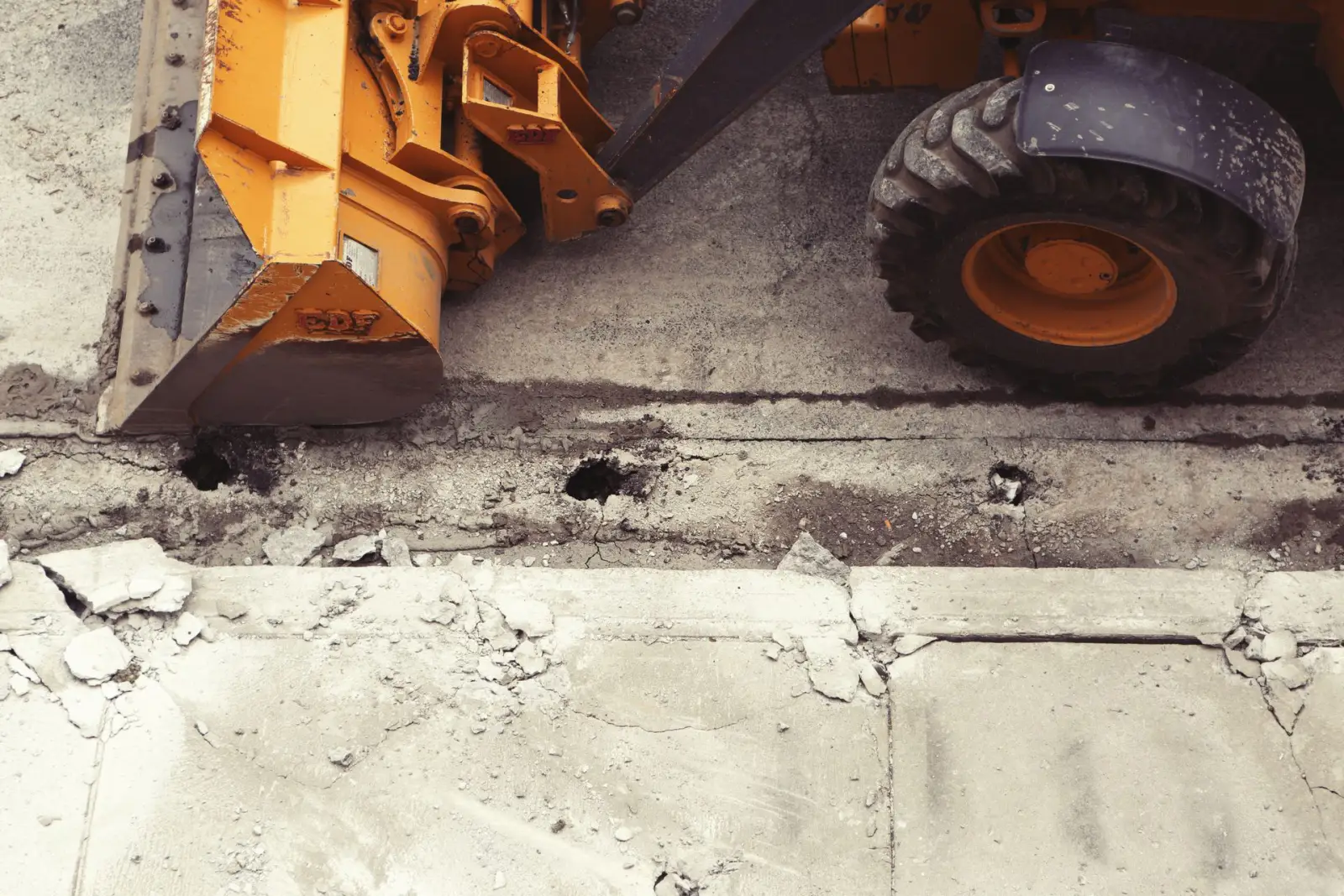
Concrete Removal in Duluth, MN — Driveway, Patio & Slab Demolition
Breaking out and hauling away old concrete, with or without a replacement pour. Priced from the access, the thickness and what's under it — all of which need looking at.
Concrete Removal & Replacement in Duluth, MN
Duluth Premier Concrete is your local resource for concrete removal and replacement throughout Duluth and St. Louis, Carlton & Lake Counties and the Twin Ports. We work with experienced local crews who price a tear-out from the access and the tonnage rather than from a guess.
Concrete removal prices on three things and none of them is square footage alone. Thickness and reinforcement determine how hard it is to break — a four-inch residential slab with fiber mesh comes apart quickly, while a six-inch slab with a rebar grid has to be cut into sections and the steel dealt with. Access determines what equipment can reach it, and on Duluth's hillside lots that is frequently the binding constraint. And tonnage determines the disposal cost, which is a real line item: four-inch concrete runs roughly 55 pounds per square foot, so a two-car driveway is several tons before anybody has poured anything new.
The other thing worth understanding is that removal is when you find out why the old slab failed. A tear-out exposes the base, the subgrade, the old drain lines, the buried downspout that has been discharging under the driveway for fifteen years, and the settled fill that nobody knew was there. That information is worth having, and it's the reason a removal-and-replacement quote should have a provision for subgrade repair rather than assuming the ground under a failed slab is fine. Pouring new concrete onto the same unrepaired base reproduces the same failure on a fresh schedule.
What's Included in a Duluth Concrete Removal Quote
- Site protection — plywood over lawn, protection for adjacent slabs, walls and landscaping
- Utility locates before any breaking or excavation begins
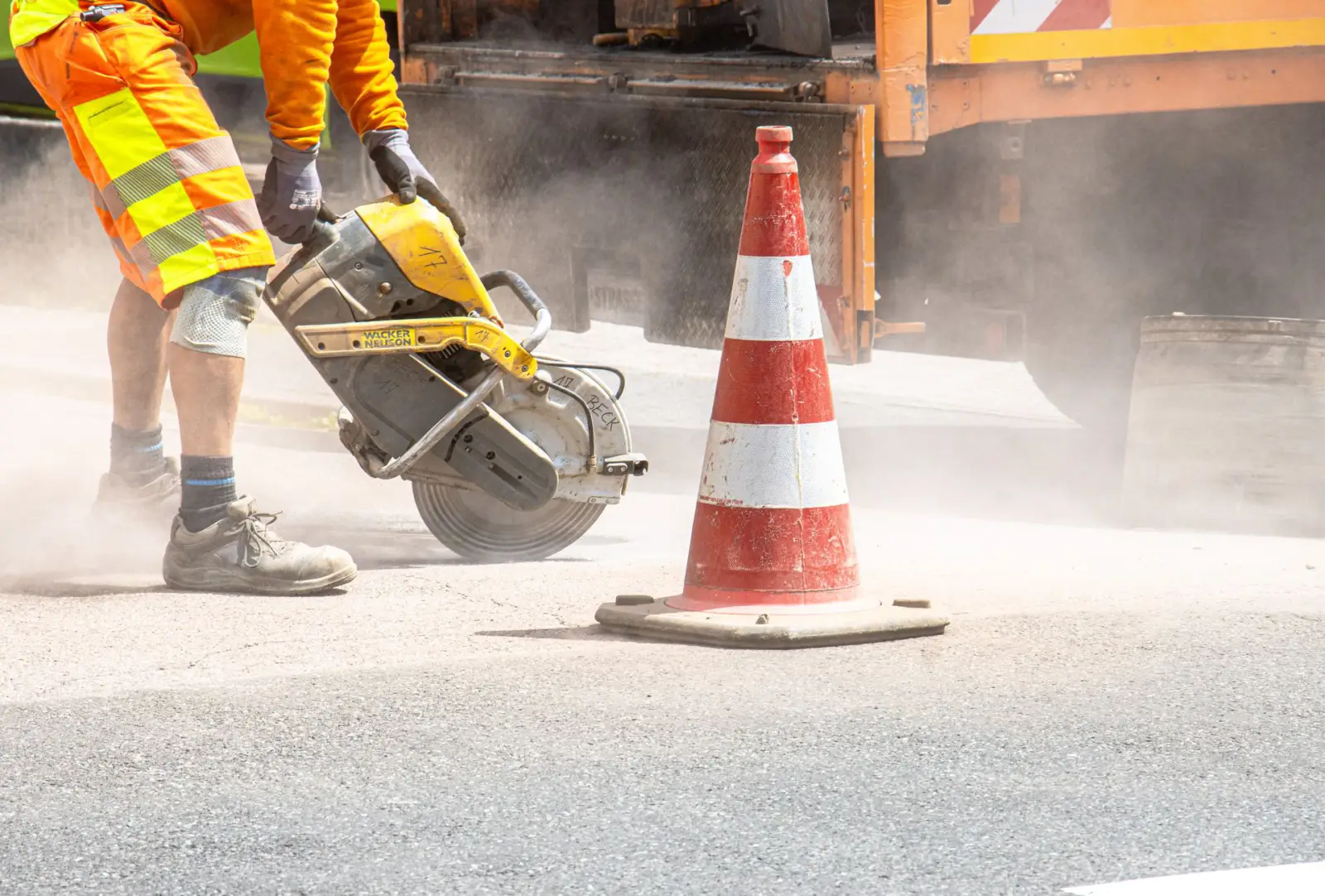
- Saw-cutting to isolate the removal area cleanly from concrete that's staying
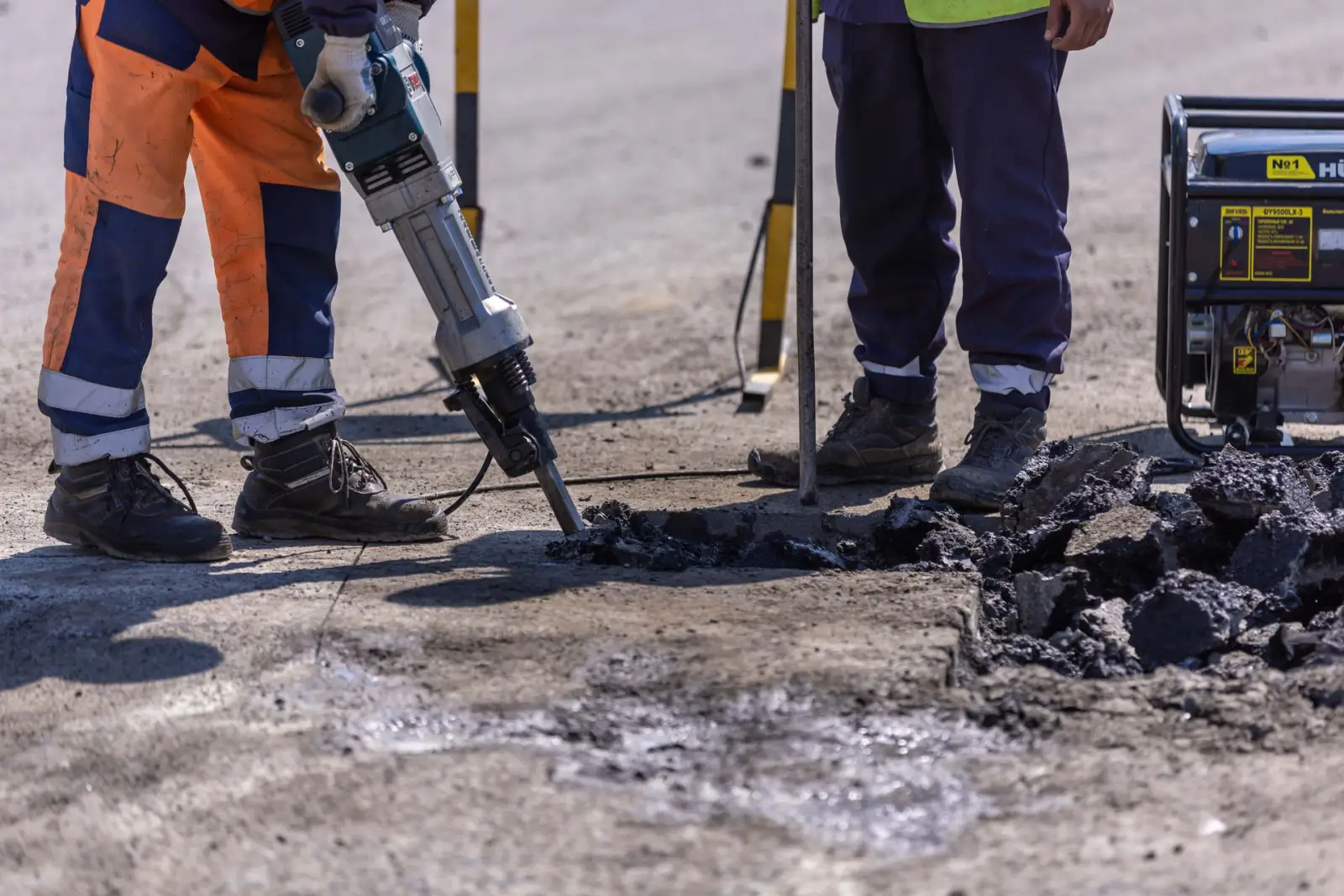
- Breaking out with equipment matched to the thickness, reinforcement and available access
- Cutting and separating reinforcement where the slab is rebar-reinforced
- Loading and haul-off of all broken material, with disposal or recycling
- Removal of the old base where it has failed, rather than leaving it in place
- Exposure and assessment of the subgrade, with findings reported before anything is backfilled
- Subgrade repair — over-excavation and compacted granular fill where the ground is soft
- Backfill and grading where no replacement pour is happening
- Full replacement pour where that's in scope, built on a properly rebuilt base
Concrete Removal & Replacement in Duluth, MN
Driveway Removal & Replacement
The largest removal job on most residential properties and the one where access decides the price. A driveway is usually reachable by machine, which makes it the easy case — a skid-steer with a breaker attachment and a dump trailer moves a lot of concrete quickly. What complicates it is the apron at the street, which may sit in the public right-of-way and carry its own requirements, and the section at the garage, where breaking out concrete right against a foundation wall or a garage slab needs saw-cutting rather than hammering so the adjacent work isn't damaged. Thickness varies more than people expect: driveways poured decades ago are sometimes thinner than four inches, sometimes considerably thicker, and occasionally there are two slabs stacked because somebody poured over the original. That last one is worth knowing before quoting tonnage.
Patio Concrete Removal
Patio removal is usually smaller than a driveway and frequently harder, because patios sit in back yards. A fenced yard with a three-foot gate, a steep grade between the driveway and the patio, mature landscaping that has to survive, and a neighbor's property line a few feet away all conspire to keep machinery out. When a machine can't reach it, the work becomes a breaker and a wheelbarrow, and several tons of concrete crosses the lawn one load at a time. That changes the labor line substantially and it's the single most common reason a patio removal quote surprises somebody. Site protection matters more here too — plywood runways over turf, protection for the house wall, and a plan for where the material stages before it's loaded. Worth asking about at the estimate rather than discovering on the day.
Sidewalk & Walkway Removal
Sidewalks are the most modular concrete on a property, which makes selective removal genuinely practical. Panels are saw-cut at existing joints and lifted out individually, leaving sound sections untouched, and that keeps a lot of walkway jobs small. The judgment call is how much to take. Removing two failed panels from a walk whose base was never right just means removing two more next year, so the decision depends on whether the failure is localized or systemic — and the tear-out itself usually answers that, since what's under the removed panels tells you what's under the rest. Where a walk runs along a house, removal is also the opportunity to fix whatever was sending water under it, and where it meets the public sidewalk, the boundary between private work and right-of-way work gets established before the saw comes out.
Concrete Slab Demolition
Garage floors, shed pads, old foundations, equipment pads and slabs inside buildings. Interior slabs are the constrained case: no room for full-size equipment, a single door for everything to leave through, walls and footings that have to be protected, and dust and noise contained. A garage floor comes out through the overhead door in a skid-steer bucket if one fits, or in a wheelbarrow if it doesn't. Old foundation slabs and stem walls are heavier work again, since they're thicker, usually reinforced, and often tied to footings that also need removing. Thickness discovery matters here more than anywhere: an equipment pad or an old shop floor can be eight or ten inches with a heavy rebar grid, which is a completely different job from the four-inch slab a quote assumed. Test drilling or a core before pricing is reasonable on anything unknown.
Old & Damaged Concrete Replacement
Removal and a new pour as a single scope, which is how most of this work actually happens. The advantage of one contractor doing both is that the subgrade gets dealt with properly in between — the crew that finds the settled fill is the crew that has to pour over it, which aligns everybody's incentives. The step that shouldn't be skipped is the pause after removal: the exposed subgrade gets looked at, the failure cause gets identified, and any correction gets agreed before the base goes back in. A quote structured as demolition plus a pour with no provision for what's found underneath is a quote that will either produce a change order or produce a slab that fails the same way the last one did. Where the old base is sound and the slab simply reached the end of its life, that's good news and it should be confirmed rather than assumed.
Signs Concrete Needs Removing
- Cracks that have stepped out of level, so sections of the slab no longer sit flush
- Settlement at a corner or along an edge, with water now ponding or running the wrong way
- Deterioration across most of the surface, where patching would cost more than replacing
- The slab has heaved and is no longer draining away from the building
- Repeated repairs at the same spot that keep failing — the slab is still moving
- You're changing the layout: removing a slab entirely, relocating a driveway, taking out an old foundation
- An old slab is in the way of new construction, landscaping or an addition
- Concrete poured over an earlier slab, where the stack is now failing as a unit
How Concrete Removal Works
- 1
Assess thickness, reinforcement, access and tonnage
A removal quote needs four numbers and only one of them is area. Thickness gets checked at an edge or, where none is exposed, by drilling — the difference between a four-inch slab and an eight-inch one is double the tonnage and considerably more than double the breaking effort. Reinforcement matters just as much: fiber mesh comes apart with the concrete, welded wire mats have to be cut and rolled, and a rebar grid means saw-cutting the slab into liftable sections. Access decides the equipment, and this is where Duluth lots get expensive — a back yard behind a steep driveway, a gate too narrow for a skid-steer, a hillside lot with no route for a dump trailer. Where machinery can't reach, the job becomes hand breaking and wheelbarrows, and that has to be priced honestly rather than discovered. Utility locates get called at this stage, not on the morning of the work.
- 2
Protect the site and saw-cut the boundary
Before anything breaks, the parts that are staying get protected. Plywood runways go over turf where material will cross it. Adjacent slabs, foundation walls, steps and landscaping get physical protection, because a breaker working next to a garage slab or a foundation will damage them otherwise. Then the removal boundary is saw-cut — a clean vertical cut where the removal meets concrete that's staying, which gives the new pour a square edge to work to and keeps the breaking from propagating cracks into the section you're keeping. This matters especially at a garage apron, at a public sidewalk, and wherever selective panel removal is happening. Cutting first is slower than hammering to a rough line and it's the difference between a clean joint and a ragged one that the new work will have to hide.
- 3
Break, separate steel and haul out
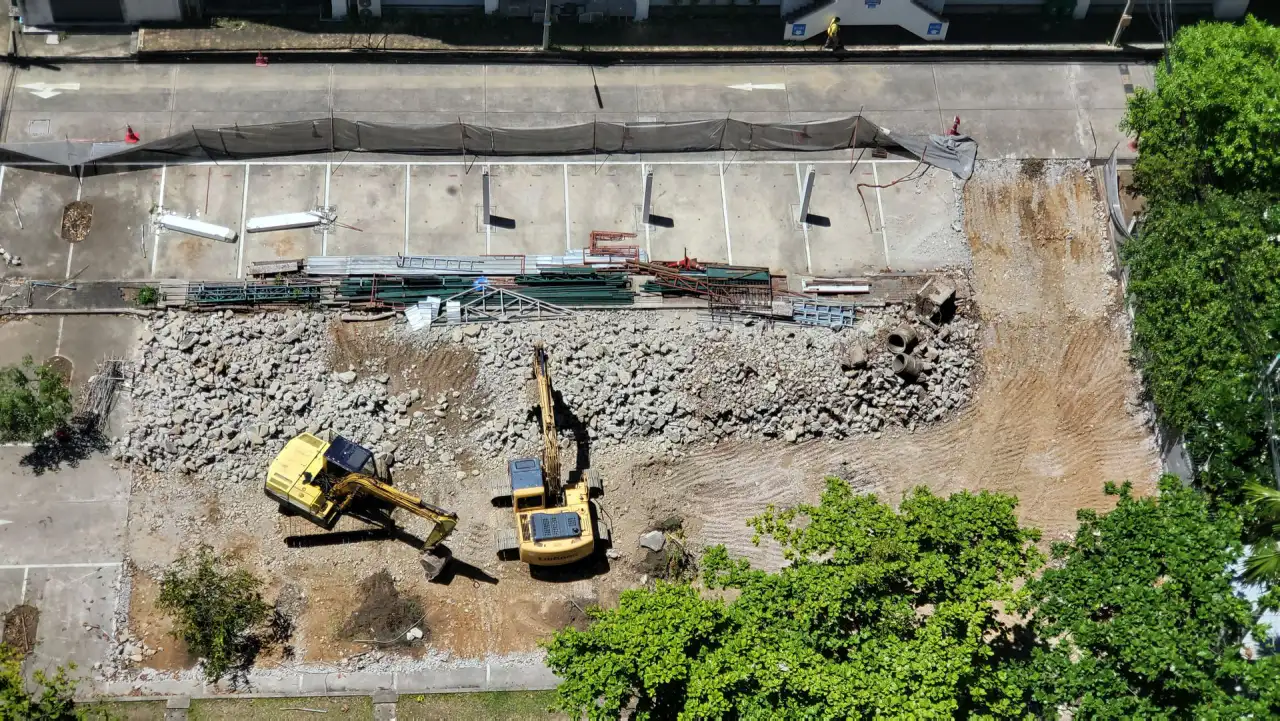
The slab comes up. Equipment is matched to the situation: a hydraulic breaker on a skid-steer or mini-excavator where there's room, a handheld breaker where there isn't, and a saw to section anything with a heavy rebar grid. Reinforcement is cut free and separated as the concrete comes apart, both because it can't go in a load of clean concrete for recycling and because a mat of rebar hanging out of a truck is its own problem. Material is loaded and hauled, with clean concrete going to recycling where it's available rather than to landfill — it gets crushed and reused as aggregate, which is both cheaper and a better outcome. The old base comes out too wherever it has failed. Leaving a compromised base in place because the slab above it is gone is how a replacement pour inherits the previous slab's problem.
- 4
Expose the subgrade, report, and repair or backfill
With everything removed, the subgrade is exposed and this is the most informative moment of the whole job. Settled fill, unstripped organic material, a void where something washed out, a saturated area fed by a downspout or a broken drain line, an old stump hole — all of it is visible now and all of it explains something about why the previous slab failed. Findings get reported before anything is covered up, because that's when the decision about scope can still be made cheaply. Soft or organic material gets over-excavated and replaced with compacted granular fill. A water source gets rerouted. If a replacement pour is in scope, the base then gets rebuilt properly — Class 5 aggregate compacted in lifts — and the pour proceeds. If not, the area is backfilled and graded so it drains, and the surface is restored to whatever it's becoming.
What Does Concrete Removal Cost in Duluth, MN?
- Square footage and slab thickness, which together set the tonnage
- Reinforcement type — fiber mesh, welded wire or a rebar grid, each a different removal method
- Access, and whether machinery can reach the slab or the work is hand breaking and wheelbarrows
- Disposal or recycling fees, which scale directly with weight
- Saw-cutting to isolate the removal area from concrete that's staying
- Site protection for lawn, landscaping, adjacent slabs and structures
- Whether the old base also has to come out
- Subgrade repair found once the slab is off — over-excavation and engineered fill
- Interior work, where dust containment and a single access door slow everything down
- Whether a replacement pour is part of the same scope
Demolition of an existing driveway typically adds around $1.40 to $2.30 per square foot on top of the replacement cost, per HomeBlue's Duluth figures — but that assumes a machine can reach it. Where it can't, hand breaking and wheelbarrowing several tons of concrete out of a back yard can cost multiples of that, and it is the single most common reason a removal quote comes in higher than expected. The other consideration worth naming: a quote that includes demolition and a new pour but has no provision for subgrade repair is incomplete. What's under a failed slab is usually part of why it failed, and finding out after the base is already going back in is the expensive order to do it in.
What to Look for in a Duluth Concrete Removal Contractor
They check thickness before quoting tonnage
A slab twice as thick as assumed is twice the disposal weight and considerably more breaking. Drilling a test hole takes minutes. A quote written from surface area alone is a quote with a change order built into it.
Access is discussed honestly
If a machine can't reach the patio, the job is a breaker and wheelbarrows and the price reflects that. A contractor who walks the route to the work and says so up front is more useful than one who discovers the gate width on the day.
They saw-cut the boundary rather than hammering to a line
A clean vertical cut protects the concrete that's staying and gives the new pour a square edge. Breaking to a rough line propagates cracks into work you're keeping, and it shows in the finished joint.
They stop and show you the subgrade
The moment the slab is off is the only cheap moment to decide about the ground underneath. A crew that pauses, reports what they found and prices the correction is a crew planning for the new slab to outlast the old one.
Residential & Commercial Concrete Removal & Replacement
Residential
Residential removal is driveways, patios, walks, garage floors and old shed pads — a West Duluth driveway with two stacked slabs, a Lakeside patio that has to come out by wheelbarrow because the only gate is three feet wide, an old foundation in the way of a new garage. Access is the recurring theme on hillside lots.
Commercial
Commercial removal covers parking areas, loading aprons, warehouse floors and site concrete, with different constraints: phasing so the property keeps operating, night and weekend work windows, traffic control, and dust and noise management around tenants. That work is scoped alongside commercial repair and replacement rather than here.
When Concrete Removal Isn't the Right Call
- A slab that could be resurfaced. If the concrete is level and stable and only the surface has failed, an overlay costs a fraction of removal and replacement. Get that assessed before committing to a tear-out.
- A small pad you could break up yourself. A 4 by 4 condenser pad is a rented breaker and an afternoon. Paying mobilization and disposal for it doesn't make sense.
- Removal with no plan for what replaces it. Bare subgrade where a driveway used to be turns into mud and erosion quickly. Decide what's going there before the concrete leaves.
- Concrete that's in the way of a project that isn't funded yet. Removal is cheapest as part of the work that follows it, since the site protection, access and machinery are all there once.
- Sites outside St. Louis, Carlton and Lake Counties. Haul distance affects disposal cost directly, and a crew mobilizing a long way for a small tear-out doesn't price well for anybody.
Frequently Asked Questions
- How much does concrete removal cost in Duluth?
- Demolition of an existing driveway typically adds about $1.40 to $2.30 per square foot to a replacement, per HomeBlue's Duluth figures. That assumes machine access. Where equipment can't reach — a fenced back yard, a steep hillside lot, an interior slab — hand breaking and wheelbarrowing the material out can cost several times that, and access is the biggest single variable.
- How heavy is a concrete slab?
- Roughly 55 pounds per square foot at four inches thick, so a 20 by 20 patio is about 11,000 pounds and a two-car driveway is several tons. That weight is what drives disposal cost and what determines whether the material can be carried out by hand or needs machinery. Thickness discovery matters — an eight-inch slab doubles all of it.
- Can I remove concrete myself?
- A small pad, yes — a rented breaker and a trailer will handle a condenser pad or a short section of walk. A driveway or patio is a different matter: the tonnage, the disposal logistics and the reinforcement all scale badly for a homeowner, and disposal facilities charge by weight whether the material arrives in a dump truck or a pickup.
- Is old concrete recycled?
- Clean concrete generally is — it gets crushed and reused as aggregate base, which is both cheaper than landfill and a better outcome. The reinforcement has to be separated out first, which is part of why rebar-reinforced slabs cost more to remove. Concrete contaminated with other materials usually can't go the recycling route.
- What happens if you find a problem under the slab?
- That's the expected outcome rather than the surprise, and it's the reason removal is informative. Settled fill, organic material, a void, a leaking downspout — any of these gets reported before anything is covered back up, because that's the only cheap moment to decide about it. A removal quote should have a provision for subgrade repair rather than assuming there won't be any.
- Do I need a permit to remove concrete?
- Work entirely on private property usually differs from work in the public right-of-way, and a driveway apron between the street and the sidewalk line frequently falls into the latter. Removing a structural slab or an old foundation can have its own requirements. The contractor should be establishing this with the city before the saw comes out.
Learn More
- Minnesota Pollution Control Agency — Construction & Demolition Waste — State guidance on how construction and demolition material, including concrete, has to be handled, recycled and disposed of in Minnesota.
- City of Duluth — Residential Code Requirements Summary — Local residential requirements, useful for establishing what's permitted work and what falls in the public right-of-way.
- International Concrete Repair Institute — Technical guidance on assessing concrete condition — the reference behind deciding whether a slab warrants removal or can be repaired or resurfaced instead.
Need Concrete Removal in Duluth, MN?
Tell us what’s going on and get an on-site estimate — no charge for the visit, and no obligation to book the work.
Get My Free Estimate